
AI for law firms and legal teams.
Custom AI that reads leases and disclosure and cites every field to its source line.
What AI can do before the advice
AI handles the reading that comes before the advice: pulling the dates, sums and break clauses out of a lease, sorting a disclosure set into what matters and what does not, drafting a routine engagement letter from your own precedents, and finding the clause buried somewhere in the matter file.
How we engage with law firms
Most engagements start with the AI Audit, with scope and fee agreed before the work starts. Some firms then continue with an Embedded AI Lead engagement to implement the roadmap, while others commission a bespoke build.
- AI Audit We measure where the week actually goes and hand back:
- Executive summary
- Interview and findings report
- Implementation roadmap
- Costing and benefit assessment
- Embedded AI Lead We implement the priorities you agree inside a defined delivery allocation, while your fee-earner still signs the advice. from £5,000 a month
- AI Charter It records what AI is used for in the firm and who signs off each workflow it touches. optional, +£3,000
Implementing the plan is a separate decision. What goes live is measured against the fee-earner hours the audit counted.
Already running inside UK law firms
For BAiSICS, OpenKit built the platform that cut a commercial lease first read from two hours to ten minutes, with every extracted field cited to the lease line it came from. Its extraction accuracy is 96%, and the platform runs inside an AWS UK region. For Pubs Advisory Service we turned fifty-page commercial pub leases into citation-anchored answers, delivered in the inbox its advisors already work from.
Where firms like yours start.
It reads the lease end to end and reports each field cited to its source line.
It classifies the disclosure set and surfaces the documents that matter, with the reason attached to each.
It assembles the client file, checks it against your risk policy and drafts the engagement letter.
It finds the clause buried in a matter file and shows the page it sits on.
It is built against your own precedents and scoped to the document system your firm runs.
Your fee-earners spend less of the week reading, and every answer traces back to the page it came from.
The audit works out yours.
Legal work we have delivered
Both are live services in commercial lease work, and both show their working so a fee-earner can check every answer.
 BAiSICS Cutting the first read from two hours to ten minutes Custom OCR and a bespoke pipeline extract at 96% accuracy, and the fee-earner can check every field against the page it came from. £200K+ Saved per year
 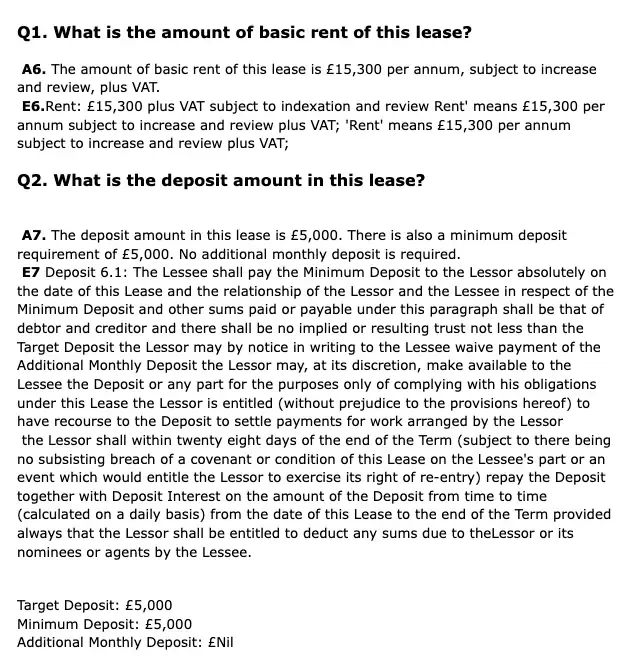 Pubs Advisory Service Answering a fifty-page lease in the inbox advisors already use Each answer comes back anchored to the paragraph it came from, so the advisor can check it against the lease without opening the lease. 13 clauses Extracted with the lease wording attached
 BAiSICS was benchmarked against historic leases that senior partners had already marked up, and 96% of its extracted fields matched the partner’s read where GPT-4 and the leading legal-AI products missed the firms’ own accuracy bar. It runs inside an AWS UK region. How firms adopt AI under SRA duties
“Our system analyses large, complex and poor quality documents with remarkable accuracy, surpassing solutions like GPT-4 and other AI legal tools. The transparency is fantastic … you can instantly verify every AI output against source documents, which builds trust with our users.”
Secure and private, as standard
We settle privilege before any model touches a file, and your client files never train someone else’s system. Private AI
ISO 27001, ISO 9001 and Cyber Essentials are certifications we hold, and we operate to UK GDPR. Your firm owns the advice and the file.
The questions that decide it
What does an AI consultancy for UK law firms actually do?
We open with an AI Audit of your workflows, document management system, precedent library and SRA-facing supervision model. You get a findings report, a prioritised roadmap and a costed business case. What follows sits on the stack you run, with the team trained to verify, disclose and record.
Will AI replace solicitors?
No. The SRA regulates outcomes and the firm stays accountable for AI-generated work the way it is for a junior’s. The Law Society requires solicitors to verify outputs, disclose material use and keep records. Our systems are built for that, citing every extracted field to its source.
How does this work with the SRA Code of Conduct and the Law Society’s generative AI guidance?
The SRA’s outcomes-based regime leaves supervision with the firm, and the Law Society’s generative AI guidance sets the verify, disclose, record rule. Every pipeline produces an audit trail tied to source documents, low-confidence outputs are held for human review, and the COLP gets a governance pack.
What about professional indemnity insurance if AI gets something wrong?
Cover sits on the solicitor, not the model, and the Law Society is clear that using AI does not exempt a solicitor from liability. We surface model confidence, cite every output to its source paragraph, hold low-confidence items for review, and produce a trail an insurer can read.
Can we keep client data inside our own tenant or on-premises?
Yes. Privileged communications and matter data stay inside the firm’s environment by default. We deploy against Claude on UK or EU regions, OpenAI on Azure UK or EU, or open-weights models on private GPU or on-premises. The BAiSICS platform runs inside an AWS UK region.
Does this integrate with iManage, NetDocuments, LEAP, Clio, Actionstep, HighQ and Microsoft 365?
Yes: those are the document and practice-management systems the builds sit against. LEAP and Microsoft 365 are evidenced in delivered work. iManage, NetDocuments, Clio, Actionstep and HighQ are integration targets scoped into each engagement, and the audit names which one is in scope before a build commits.
How does this compare to Harvey, Spellbook, Robin AI or Luminance?
Harvey and Luminance sit at the enterprise tier, with seat pricing typically above $1,000 per fee-earner a month against a generic model. Spellbook is a productised drafting tool. OpenKit is a different shape: bespoke against your precedents, your document system and your matter taxonomy, with no per-seat lock-in.
What does a legal AI engagement cost, and how is it structured?
The audit is £10,000 excluding VAT for the scope agreed before the work starts. An AI Charter can be added for a further £3,000 excluding VAT, scope agreed separately. An Embedded AI Lead engagement is from £5,000 a month excluding VAT. We give you indicative figures on a call.
Have you delivered AI work for UK law firms and legaltech businesses?
Yes. BAiSICS took commercial-lease review from around two hours a document to roughly ten minutes at 96% extraction accuracy against partner-graded benchmarks, saving over £200K a year. Pubs Advisory Service turns fifty-page pub leases into citation-anchored answers in the inbox its advisors already work from.
What makes OpenKit different from a Big Four AI consultancy?
The Big Four sell strategy and hand implementation to a different team on a different budget. Assessment and delivery sit with one firm here, under a lead we agree with you. The audit ranks and costs the work, and a build that follows is priced from that roadmap.
What could your business do with AI?
Find out with experts who become part of your team. We uncover opportunities, get ideas working, and help your people build on the results. We reply within one working day.