AI for UK Insurance Firms and Brokers | OpenKit

AI for UK insurance firms.

AI is moving into UK insurance faster than most firms know how to assess it under SMCR and Consumer Duty. We help you map where it fits across the firm, and build bespoke systems where the work calls for it. Across carriers, MGAs, Lloyds syndicates, brokers and claims-management firms.

ISO 27001 certified ISO 9001 certified Cyber Essentials
The City of London skyline, home to the UK insurance market
£8.4bn
UK insurance fraud detected in 2023 across claims and application fraud.
Source: Association of British Insurers, 2024

OpenKit helps UK insurance firms (carriers, MGAs, Lloyds syndicates, brokers and claims-management firms) work out where AI fits across their firm and builds bespoke systems where the work calls for it. Every engagement starts with a fixed-fee, fixed-scope audit and a prioritised rollout plan. OpenKit holds ISO 27001, ISO 9001, and Cyber Essentials certifications.

OpenKit is a UK AI consulting firm that helps insurance firms (carriers, MGAs, Lloyds syndicates, brokers and claims-management firms) work out where AI fits across their firm and builds bespoke systems where the work calls for it. OpenKit delivers claims document understanding, handler and complaints copilots, underwriting and fraud-signal triage, and private knowledge systems shaped to each firm's own policy wordings and stack. OpenKit has ISO 27001, ISO 9001, and Cyber Essentials certifications and works with clients across the United Kingdom from a base in Cambridge.

What we keep hearing
from insurance leaders.

Four patterns we see in every insurance audit. Each one is also a reason most off-the-shelf AI rollouts stall before the customer outcome is ever measured.

£8.4bn
UK insurance fraud detected in 2023. The figure is what the existing controls catch, not what they miss.

Claims and conduct have outrun the controls.

The board has approved an AI claims pilot and a fraud-detection retrofit; the FOS is reading every repudiation through Consumer Duty; and nobody can name the senior manager who owns the model under SMCR.

Source: Association of British Insurers Detected Fraud Statistics, 2024.
PATTERN 02

Consumer Duty applies to every AI-assisted outcome.

Whether the algorithm refused the renewal, downgraded the cover, declined the claim or routed the complaint, the FCA reads it as a customer outcome the firm is accountable for. A repudiation letter drafted by a model is still the firm’s repudiation letter.

FCA Consumer Duty · PS22/9 outcome rules
PATTERN 03

The new ADM regime forces human-in-the-loop on significant decisions.

Section 80 of the Data (Use and Access) Act 2025 came into force on 5 February 2026, replacing UK GDPR Article 22. Claim repudiations, renewal refusals and pricing decisions now require explanations, representations, and a human reviewer with real authority to override the AI.

Data (Use and Access) Act 2025 · in force 5 Feb 2026
PATTERN 04

FOS exposure does not transfer to the algorithm.

FOS rulings have been consistent: a model declining a claim or rejecting a complaint does not transfer accountability away from the firm. ICOBS, SYSC operational resilience and PRA SS1/23 push toward AI inside the firm’s controlled estate, with audit logging, model-risk evidence and data lineage available on request.

FCA ICOBS · PRA SS1/23 model risk management principles

Where AI tends to fit
in UK insurance.

These are the areas that come up most often in insurance audits. We don’t ship them off the shelf. Every implementation is shaped to your firm, your stack, and what is safe to defend to your conduct, prudential and complaints reviewers.

Claims handler reviewing FNOL documents
01 — Claims document understanding

FNOL to decision, with citation built in.

FNOL extraction, schedule of loss summarisation, medical-report and engineer-report parsing, repudiation-letter drafting against the firm’s own templates. Every output anchored to the source paragraph so a handler or compliance reviewer can verify before the letter leaves the firm.

  • FNOL and schedule-of-loss extraction
  • Repudiation letter drafting against firm templates
  • Cited against the source page on every clause
  • Audit log retained per FCA SYSC and ICO guidance
02 — Claims handler & complaints copilots

The audit trail is the product.

Triage, reserving recommendations, complaints triage, vulnerable-customer flagging. Every interaction logged with timestamp, prompt, retrieved context, model version and confidence so the responsible senior manager has a defensible per-case trail.

  • Triage and reserving recommendations for handlers
  • Complaints triage with reason-code routing
  • Vulnerable-customer flagging into the existing process
  • Per-case SMCR-ready evidence pack
Underwriter reviewing risk-management documentation
03 — Underwriting & fraud signal

LLMs extract. Rules decide. Both are traced.

Submission triage, risk-pack summarisation, fraud-signal triage alongside IFB / CIFAS checks. The model extracts and surfaces; the conclusion is derived from rules and an underwriter or investigator with authority to override. Never auto-deny, never auto-cancel.

  • Broker-submission triage and risk-pack summarisation
  • Fraud signal as triage, not decision
  • Pricing-input extraction with rule-derived verdicts
  • Langfuse-traced prompt versioning end-to-end
04 — Internal knowledge systems

Searchable, cited answers from your underwriting manual and policy wordings.

Assistants that answer questions from the underwriting manual, policy wordings, claims-handling guidance, ICOBS sections that apply to the permissions you hold, FOS precedent and prior repudiation correspondence, citing where every answer came from. Refuses out-of-scope. Stays inside your controlled environment.

  • Underwriting manual and policy wordings indexed
  • ICOBS sections and FOS precedent searchable
  • Refuses out-of-scope, never invents a citation
  • Runs inside your controlled environment

An example of what this can look like in practice.

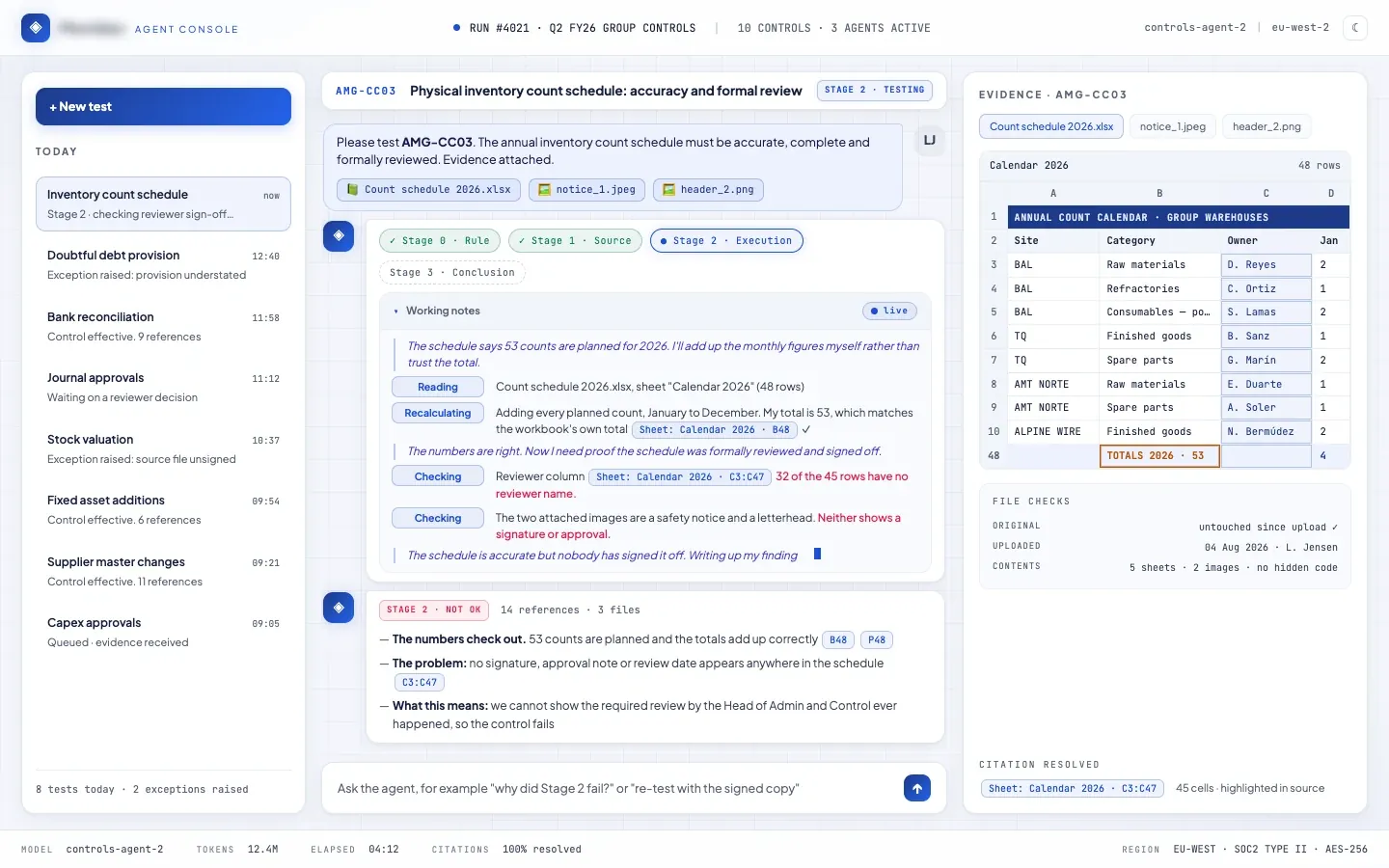
A FNOL triage with the audit trail built in. Drafts the FNOL summary and reserving recommendation from the customer call and supporting documents, cites the relevant policy wording, and queues for handler sign-off. Every prompt, citation and edit retained in the audit log. We shape work like this around your existing workflow rather than ship it off the shelf.

Claims handler reviewing AI-drafted FNOL summary
Draft only · Handler sign-off required The model never repudiates. It never closes a claim. The named senior manager owns every AI-assisted outcome.

The model drafts. The handler signs off. The SMCR holder owns it.

Work shaped like this for insurance follows a consistent shape. The model never autoreplies to a policyholder, never updates a claim status on its own, never repudiates without a handler of record signing the draft. The audit log retains the prompt, the cited paragraphs, the handler’s edits, and the final letter.

  • FNOL pack in, structured triage and reserving recommendation out
  • Cited against policy wording, ICOBS and firm templates
  • Always queues for handler sign-off, never autoreplies to the policyholder
  • Audit log retained per FCA SYSC and ICO guidance, FOS-ready
  • Runs inside your controlled environment

How we engage.

Most engagements start with the audit. What follows depends on what it surfaces. Many firms move into a transformation block on their existing policy-admin and claims-management stack, some take on a senior AI lead to keep the work moving, and a few commission a bespoke build where nothing off-the-shelf will fit.

See the full engagement model on How We Work →

The UK insurance
stack we integrate with.

We build on your existing policy-admin, claims and broker platforms alongside Microsoft 365. No rip-and-replace. Below is a sample of what we routinely integrate with. We work across many other systems too, so bring us your stack.

/ policy & claims

  • Guidewire ClaimCenter & PolicyCenter
  • Duck Creek Suite
  • Sapiens · Acturis
  • REST / SOAP APIs
  • Bespoke PAS connectors

/ document & OCR

  • M365 document libraries
  • AWS S3 (UK region)
  • Zero-retention OCR (Textract)
  • DocuSign · Adobe Sign
  • Custom FNOL pipelines

/ identity & access

  • Microsoft Entra ID
  • SAML 2.0 / OIDC
  • Role-based access control
  • Full audit logging
  • Per-claim access trails

/ LLM deployment

  • Claude UK / EU region
  • OpenAI on Azure UK / EU
  • Open-weights on private GPU
  • On-prem for sovereign
  • Langfuse trace logging
REGULATED CONTROLS: ISO 27001 ISO 9001 Cyber Essentials UK GDPR

Engagements adjacent to
UK insurance and conduct work.

Insurance-specific named engagements stay anonymised on the public site. The work below is from neighbouring regulated domains where the audit, citation and SMCR patterns apply unchanged.

— 01

Kaption

AI controls audit Four-step framework Langfuse-traced Named with permission
A six-week MVP of an AI controls-testing platform for an audit-tech founder, built around a four-step deterministic framework where the model extracts and tests but the conclusion is derived from rules. EU data sovereignty on AWS, zero-retention OCR via Textract, Langfuse for prompt versioning and trace logging, cell-level citation trails on every answer. The same pattern applies to claims and underwriting copilots.
OutcomeAlpha batch test: 79.5% alignment with the human auditor on first pass, projected 93–95% post-fix. Failure modes published in full alongside the remediation plan.
— 02

Pubs Advisory Service

Lease analysis Custom OCR + LLM Email-native Named with permission
A live AI service that turns 50+ page commercial lease agreements into citation-anchored, natural-language answers delivered through advisors’ existing inbox. Custom OCR plus a question-answering LLM, every output anchored to a source paragraph, model refuses out-of-scope questions. The same shape applies to policy-wording knowledge systems for insurance.
OutcomeLive in production. Document review at email-native latency.
— 03

A UK regulated-services firm

Multi-site Claims-pattern triage Internal customer-outcome workflows Anonymised
Audit-first engagement to map where AI fits across the firm’s customer-outcome workflows, identify named ownership for any AI-assisted decision that could end up at FOS, and propose how a transformation block could sit inside the existing Microsoft 365 and case-management estate.
OutcomeAudit scope agreed with the firm. Named ownership of AI-assisted decisions drafted in the firm’s structure. Transformation proposal in review with the firm’s leadership.

The regulatory floor
we build on.

What we hold and what we operate to. We surface gaps and propose mitigations. We are not a regulatory certifying body.

CERTIFIED

ISO 27001

Information security management. Independent third-party audited.

CERTIFIED

ISO 9001

Quality management. Independent third-party audited.

CERTIFIED

Cyber Essentials

UK NCSC baseline cyber-hygiene certification.

COMPLIANT

UK GDPR

Data processing register maintained per ICO guidance.

We hold ISO 27001, ISO 9001, and Cyber Essentials certifications independently, and operate to UK GDPR. We are not a regulator, an indemnity insurer, or a conduct auditor. We work alongside the firm’s own conduct, prudential and complaints reviewers, who own the firm’s accountability for any AI-assisted outcome.

Questions insurance leaders
and IT directors ask.

What does an AI consultancy for UK insurance firms actually do?
We audit where AI fits inside the policy lifecycle and where it does not, build on the stack you already run (Guidewire, Duck Creek, your policy admin and case-management estate, Microsoft 365), and leave a senior engineer in the team to keep claims, underwriting and complaints workflows moving safely. We do not sell strategy decks. The output is an auditable workflow your senior reviewers can defend.
Will AI replace claims handlers, underwriters or compliance reviewers?
No. The FCA's position is that senior managers retain personal accountability under SMCR regardless of how a decision was reached, and Consumer Duty applies to the customer outcome, not the tool that produced it. The DUAA 2025 requires meaningful human intervention by a reviewer with authority and competence to override the AI for any significant decision, and an insurance claim repudiation, a refused renewal, or a complaints outcome all clear that bar. We build copilots that let handlers and underwriters work through more cases at higher consistency, with a citation-anchored audit trail per interaction.
How does this work with ICOBS, Consumer Duty and the FCA Insurance Conduct rulebook?
The audit covers every workflow where AI touches a policyholder outcome (claim, renewal, complaint, vulnerable-customer flag) and produces a written report that names what is being used where, who is accountable inside the firm, and what evidence the audit log needs to retain. The conduct interpretation against ICOBS, Consumer Duty and the FCA Handbook stays the responsibility of your conduct reviewers. We produce the engineering artefacts they need to do that work; we do not certify against the rulebook ourselves.
What about Solvency II and PRA SS1/23 if we are an authorised insurer?
Solvency II governs prudential capital, not directly the AI you put in front of an underwriter, but PRA SS1/23 is technology-agnostic and captures AI and ML models used in significant business decisions. For PRA-regulated carriers the audit covers internal model use, ORSA inputs and capital-affecting decisions as separate workflows from copilot drafting, and produces the engineering artefacts (audit log shape, model versioning, data lineage) your model-risk function needs. The interpretation against SS1/23 and your existing MRM framework stays with your model-risk and prudential leads.
How do you handle Financial Ombudsman Service exposure on AI-assisted complaints and claims?
FOS rulings have been clear: an algorithm declining a claim or rejecting a complaint does not transfer accountability away from the firm. We design the workflow so any AI-assisted decision that could end up at FOS (claim repudiation, renewal refusal, vulnerable-customer triage, complaints outcome) sits behind a named human reviewer with the citations, the retrieved context, the model's confidence signal, and a real path to override. The audit log retains the full trail per FCA SYSC and ICO guidance.
Can we keep policyholder data on-prem or in a UK / EU controlled environment?
Yes. Anthropic Claude on UK / EU regions or OpenAI on Azure UK / EU as the default cloud options, open-weights models on private GPU for sovereign requirements, and full on-prem for carriers and brokers where data residency rules out cloud LLMs entirely. We also ship zero-retention OCR for claims documents, FNOL packs, medical reports and broker submissions. Every deployment carries an ISO 27001-aligned audit logging trail and a UK GDPR data processing register.
Does this integrate with Guidewire, Duck Creek, our PAS, our broker platform and Microsoft 365?
Our verified integrations include Microsoft 365 (SharePoint, document libraries, Entra ID), Power Automate for workflow integration, Salesforce Financial Services Cloud, REST / SOAP API connections, on-prem PostgreSQL, and Langfuse for prompt versioning and trace logging. For Guidewire ClaimCenter and PolicyCenter, Duck Creek Suite, Sapiens and Acturis we integrate at the API / message-bus boundary rather than re-platforming. We scope the integration honestly during the audit, and we do not name PAS platforms we have not delivered against.
How does AI help with insurance fraud detection without crossing the conduct line?
AI fraud detection works best as a triage signal, not a decision. We build pattern-recognition layers that flag claims for further investigation alongside the existing IFB / CIFAS / industry register checks. The triage never auto-denies and never auto-cancels a policy. The flag is one input to a human investigator who still owns the repudiation decision under SMCR and ICOBS. False-positive rates are tuned for the operational reality that wrongful refusal is a conduct breach and a FOS exposure, not just an inconvenience.
How long does an insurance AI engagement take, and what does it cost?
The audit is fixed-fee and fixed-scope. A Transformation Block is a build-and-train engagement priced per scope and ships configured workflows inside your existing policy-admin and claims-management stack with the team trained on them. The Senior AI Lead is a rolling monthly retainer that begins once you have a Transformation Block in production. A bespoke build (a claims-triage platform, a private knowledge system over the underwriting manual) is scoped after the audit since the price reflects what the audit surfaces. Numbers are shared during a discovery call so we can size against what you actually want to do.
How is OpenKit different from the Big Four, Insurtech UK members, or a fractional CAIO?
The Big Four split strategy and implementation across separate teams on separate budgets; the senior engineer on day one is rarely the senior engineer on day ninety. The productised insurtech offerings (Tractable, Sprout.ai, Shift Technology, Charles Taylor InsureTech) sell a product against their own model and corpus, not a build against yours. The fractional CAIO retainer puts an advisor in the room but does not write code. We do both: a senior engineer audits the work, scopes the build, ships the integration into Guidewire / Duck Creek / your PAS, trains the team, and stays on as the Senior AI Lead. Our audit is fixed-fee, which the buyer can self-qualify against without a procurement cycle.
UK INSURANCE
/ start here

Want to find where AI fits
in your firm?

Start with the audit. Fixed fee, fixed scope, a written report you can take to a board or an audit committee, and a prioritised plan for what to build first.

Start Your AI Project

Thank you for your interest. Enter your project details below and our team will get in contact within 24 hours.

About your AI project

0 / 2,000

About you

By submitting this form, you confirm that you have read and agree to our privacy policy. We will only use your information to respond to your inquiry.