Kensington and Chelsea joins Air Aware
Kensington and Chelsea is the fifth London borough on Air Aware, the free public air-quality assistant OpenKit built on the boroughs' own monitoring data.
 Ibrahim Mizi
· 3 min read
Ibrahim Mizi
· 3 min read
Air Aware is the free public air-quality assistant we built with London boroughs. It takes the real-time readings from the boroughs’ own monitoring networks and explains them in ordinary language. It launched with Hackney, the City of London, Tower Hamlets and Newham, and residents stay with it for an average of five minutes and two seconds a session, against a sixteen-second industry baseline for a government web page.
The Royal Borough of Kensington and Chelsea is now the fifth borough on the service. The council’s own air quality monitoring pages direct residents to Air Aware for the borough’s real-time data.
What Kensington and Chelsea residents get
The borough publishes a monitoring programme with five permanent continuous stations, from North Kensington to Earl’s Court, and around eighty passive diffusion tubes. Mobile sensors sit alongside them, including part of the Breathe London network.
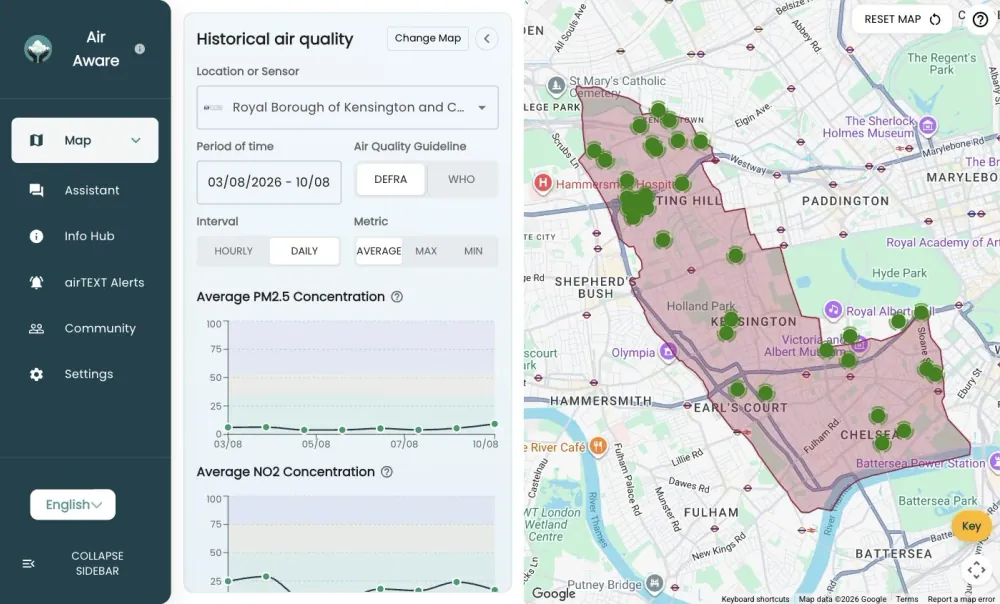
A resident selects the borough on the live map and sees the boundary with the sensors inside it, and PM2.5 and NO2 read against the Defra air quality index. They can then ask in plain language what a reading means for the school run, or for someone with asthma. The answer comes from the boroughs’ published data and public-health guidance, and the assistant does not go out to the open web for anything.
A new borough joins without a new build
More than a hundred community members shaped Air Aware across eight co-design workshops, two in every borough, before it launched. That design work was done once, so a fifth borough did not need a new build. We connected Kensington and Chelsea’s published feeds and gave the council’s communications team its own workspace, and residents there now get the same assistant reading their own area’s data.
The full Air Aware case study covers how the service was designed and what the boroughs measure. If your organisation sits on public data that residents or customers cannot yet use, that is the kind of workflow our audit exists to find.

Tell us what the build has to do.
A system distinct enough to need building gets its own scope. We agree what it has to do, quote it up front and hand over the code we write.
Keep reading
The closest pieces to this one, by shared ground.